
Between Shared Atmosphere and Formalised Relation: Contemporary Approaches to the Concept of Vibes
It got asked to define ᴠɪʙᴇꜱ on a panel yesterday at Universität Paderborn and i fortunately restrained. Especially after trying to do the same for ᦓꪶꪮρ at HIIG a couple of days ago resulting in an endless meandering string of empty words.
In April 2021 Kyle Chayka published TikTok and the Vibes Revival and that article encapsulated what i had been experiencing on TikTok. Of course without being able to put it into proper words. I kept refering back to the text in workshops whenever the omnious word constantly came popping up again and again.
Compare Robin James, 2022: Vibe became a Thing when algorithmic culture made people need a vernacular term for ambient, non-propositional, pattern-based perception. The word had been around for decades, but in the early 2010s it expanded from describing places to describing people, brands, media objects and identities — because we increasingly learned to perceive ourselves the way platforms perceive us.


So what is a 𝓥𝓲𝓫𝓮? That depends on whom you are talking with. In fact, dissecting the term, it's origins, predecessors, references is like explaining a joke. Or getting a joke explained by a roundtable of full-blown academics. Not that much fun. Yet something else.
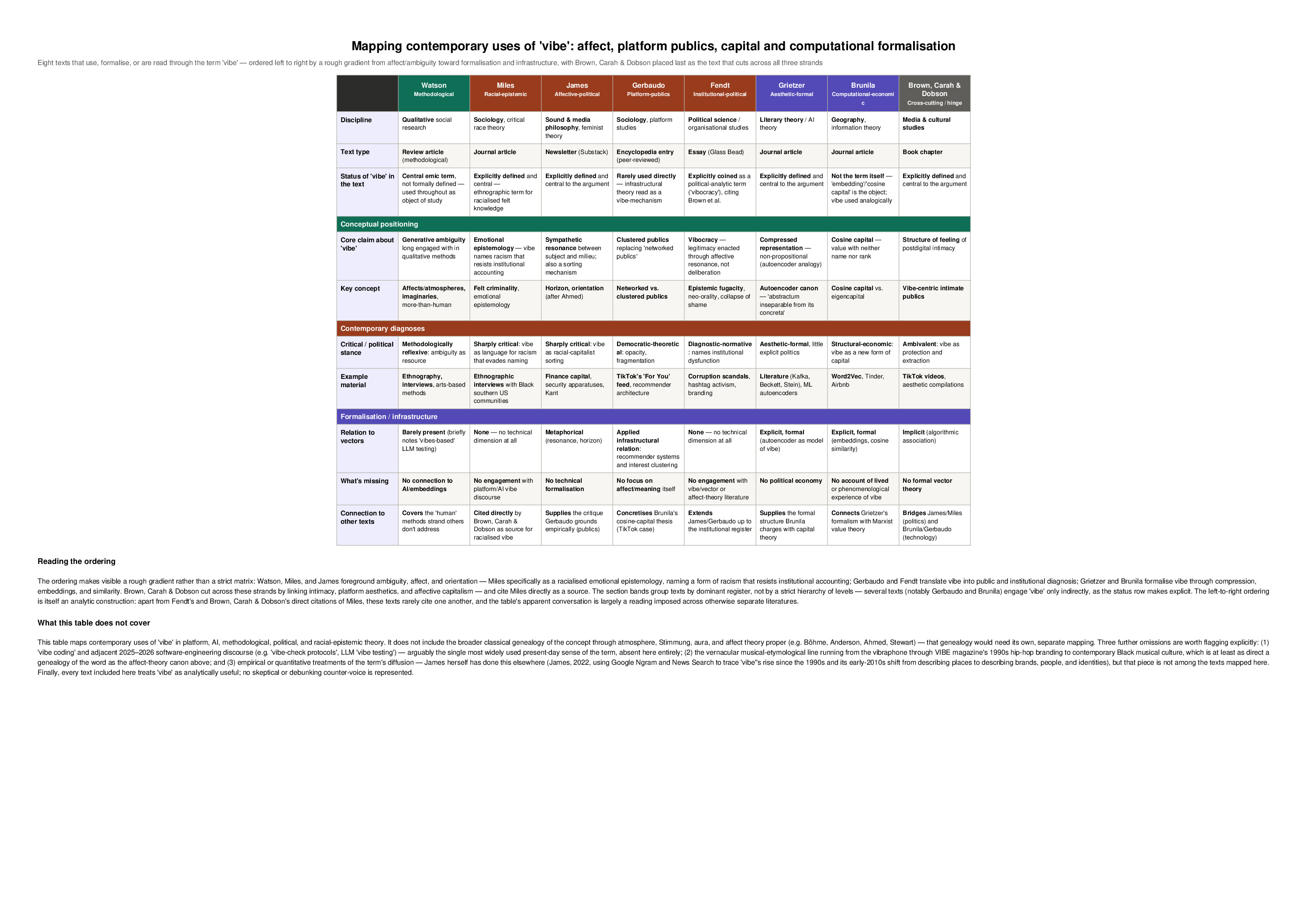
Mapping contemporary uses of 'vibe'
affect, platform publics, capital and computational formalisation*
Eight texts that use, formalise, or are read through the term 'vibe' — ordered left to right by a rough gradient from affect/ambiguity toward formalisation and infrastructure, with Brown, Carah & Dobson placed last as the text that cuts across all three strands

* surely i used Claude and ChatGPT to help with the chart. And i did not read all the texts in their entirety. Blame it on the rain, the boogie, but please blame me. This is supposed to be a quick starting point for a further investigation and not a peer-reviewed literature review. It is needed though. Here is a PDF version of the chart.
Reading the ordering
The ordering makes visible a rough gradient rather than a strict matrix: Watson, Miles, and James foreground ambiguity, affect, and orientation — Miles specifically as a racialised emotional epistemology, naming a form of racism that resists institutional accounting; Gerbaudo and Fendt translate vibe into public and institutional diagnosis; Grietzer and Brunila formalise vibe through compression, embeddings, and similarity. Brown, Carah & Dobson cut across these strands by linking intimacy, platform aesthetics, and affective capitalism — and cite Miles directly as a source. The section bands group texts by dominant register, not by a strict hierarchy of levels — several texts (notably Gerbaudo and Brunila) engage 'vibe' only indirectly, as the status row makes explicit. The left-to-right ordering is itself an analytic construction: apart from Fendt's and Brown, Carah & Dobson's direct citations of Miles, these texts rarely cite one another, and the table's apparent conversation is largely a reading imposed across otherwise separate literatures.
What this table does not cover
This table maps contemporary uses of 'vibe' in platform, AI, methodological, political, and racial-epistemic theory. It does not include the broader classical genealogy of the concept through atmosphere, Stimmung, aura, and affect theory proper (e.g. Böhme, Anderson, Ahmed, Stewart) — that genealogy would need its own, separate mapping.
Three further omissions are worth flagging explicitly: (1) 'vibe coding' and adjacent 2025–2026 software-engineering discourse (e.g. 'vibe-check protocols', LLM 'vibe testing') — arguably one of the widely used present-day sense of the term, absent here entirely ; (2) the vernacular musical-etymological line running from the vibraphone through VIBE magazine's 1990s hip-hop branding to contemporary Black musical culture, which is at least as direct a genealogy of the word as the affect-theory canon above; and (3) empirical or quantitative treatments of the term's diffusion (e.g. corpus or Ngram analyses of its rise since the 1990s). Finally, every text included here treats 'vibe' as analytically useful; no skeptical or debunking counter-voice is represented.
Dive Deeper, My Dear
Brown, M. G., Carah, N., & Dobson, A. S. (2026). The vibe factory: Intimacy, affective capitalism and digital media. In A. Evans, J. Hakim, J. Ringrose, A. S. Dobson, & S. McGlotten (Eds.), Postdigital intimacies: Relational lives in the networked public-private (pp. 25–44). UCL Press. https://doi.org/10.14324/111.9781806550531
Brown, M. G., Carah, N., Robards, B., Dobson, A., Rangiah, L., & De Lazzari, C. (2024). No targets, just vibes: Tuned advertising and the algorithmic flow of social media. Social Media + Society, 10(1). https://doi.org/10.1177/20563051241234691
Brunila, M. (2025). Cosine capital: Large language models and the embedding of all things. Big Data & Society, 12(4), 1–20. https://doi.org/10.1177/20539517251386055
Fendt, J. (2025). Vibocracy and the collapse of shared reality. Encyclopedia, 5(4), Article 163. https://doi.org/10.3390/encyclopedia5040163
Gerbaudo, P. (2026). TikTok and the algorithmic transformation of social media publics: From social networks to social interest clusters. New Media & Society, 28(3), 1019–1036. https://doi.org/10.1177/14614448241304106
Grietzer, P. (2017). A theory of vibe. Glass Bead: Site 1. Logic Gate: The politics of the artifactual mind. https://www.glass-bead.org/article/a-theory-of-vibe/
James, R. (2021, January 29). What is a vibe? On vibez, moods, feels, and contemporary finance capitalism. Its Her Factory [Newsletter]. https://itsherfactory.substack.com/p/what-is-a-vibe
Miles, C. J. (2023). Sociology of vibe: Blackness, felt criminality, and emotional epistemology. Humanity & Society, 47(3), 365–384. https://doi.org/10.1177/01605976221146733
Watson, A. (2025). Vibes-based methods. Qualitative Research, 25(6), 1326–1343. https://doi.org/10.1177/14687941241308707
I'd rather not
Not yet sure if i want to digg deeper here. In fact i came here because i have problems pinning down other terms these days. 🅂🄻🄾🄿 for example. Slopification, Mon Amour. And VΣᄃƬӨЯƧ. Vector Media.
